

A Step Back
A portal, of sorts…

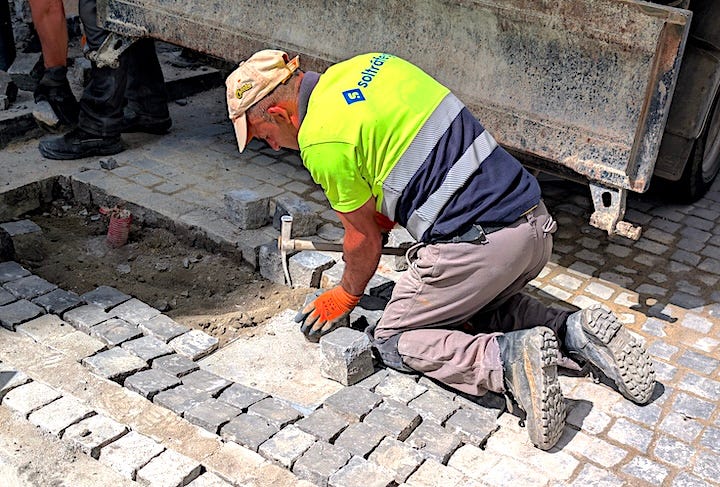
To make a rectangular cobblestone like those that pave the streets of the old city of Porto, masons first scribe a line on a piece of basalt, following natural grain if there is one. With a chisel they deepen that line into a groove, then a crevice, and then, with a crack, split the rock.
The cobblestones I saw in Porto were mostly square, maybe four or five inches on a side. But they’re not a cube: they are deeper than they are broad, maybe seven inches from the top to where they are set into the ground. It would seem that gives them stability, but I’m no engineer.
Others are longish, like bricks.
I didn’t actually see cobblestones made. There was a pile beside the road being repaired, and I assume they were being recycled. A mason was chipping off what appeared to be dried mud and tossing them to two men setting them in place.
They roughly bedded the stones by pulling dirt and sand to where needed with the broad, chisel-end of their hammer. They didn’t put much effort into making the bed smooth. They put the stone in place and with the flat hammer end, or the butt of the handle, pounded the cobble to a depth where it was even with the others.
It’s not a fine or delicate process despite the relative evenness of the result.
It’s estimated there are about 300 million cobblestones in Porto, more or less, depending on whether they were 5x5 or 5x8. The thought of the labor for all that is staggering. Each cobble has six faces. Each stone has to be bedded individually.
It’s a good thing cobblestone streets last for hundreds of years.
Where the architecture of Madrid was grand, imposing, Porto feels like a pirate haven where narrow streets weave between narrow buildings up and down steep hills. One building was maybe three meters (a little less than 10 feet) wide, between two others about the same. It held a shop with brushes that varied in size from whisks two inches wide to brooms, all appearing hand-made.
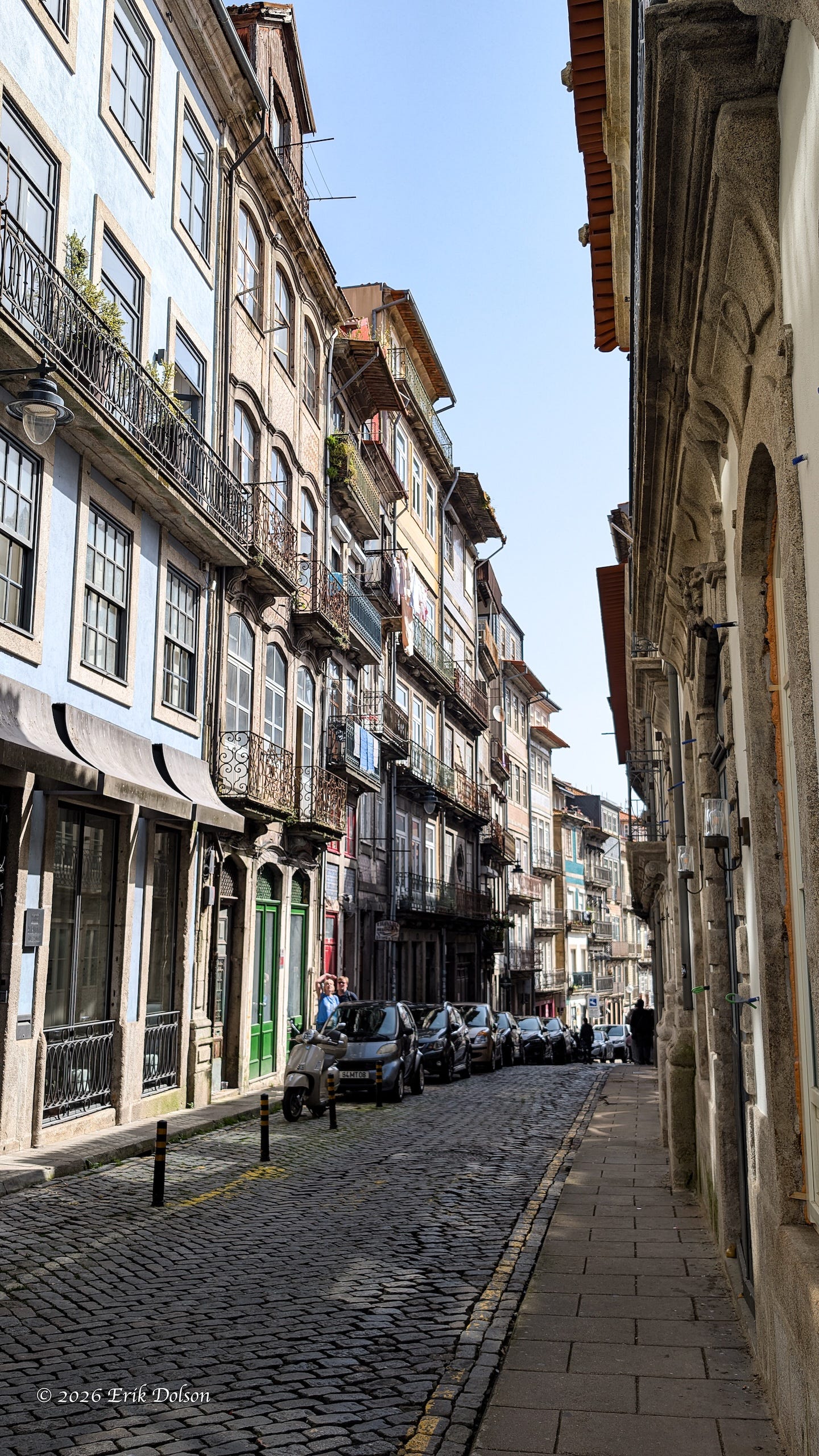
Techniques from hundreds of years ago.
There was no barrier to entry at Clérigos Church, so I wandered up stone steps with swales worn deep from the passage of countless worshippers since it was built in 1732. At the top there were thick stone balusters pitted deep but not crumbling. Even stone dissolves over time from an onslaught of acid rain and car exhaust, I supposed.
When I entered the church proper I took off my ball cap. It just felt like the right thing to do.
The inside of the church glowed. The designs on the arched ceiling were brilliantly lit, niches in the walls sheltered carvings of Mary and statues of saints. There was a description of the day when the first foundation stone was carried to the site, as if in a sacred casket.
I don’t usually wear ball caps but I’d left my wide-brimmed hat back in the room and the sun was intense and flared across my sunglasses, making it difficult to see and feel the colors of Porto.
I bought this one an hour before at the mercado where I also bought a hamburger, no fries, that was surprisingly good. It was a burger or a slice of pizza, but that would have been an assault on my stomach I wasn’t willing to risk.
I also had a can of Coke, telling myself to be wary of letting blood sugar drop too low, but of course that was just an excuse.
There was a story that went along with the ball cap with the word “Humano” embroidered in small, simple letters above the brim. “Human.” A message I could support at a time when it seems we forget what binds us together, with war recasting our shared past and AI threatening our future.
The depth of Porto, the history in its cobblestones, makes me feel so temporary. Human.
Beautiful word picture, thanks for sharing 🩵