

Approaching the Edge
Vertigo Is a Thrill (until it's not)

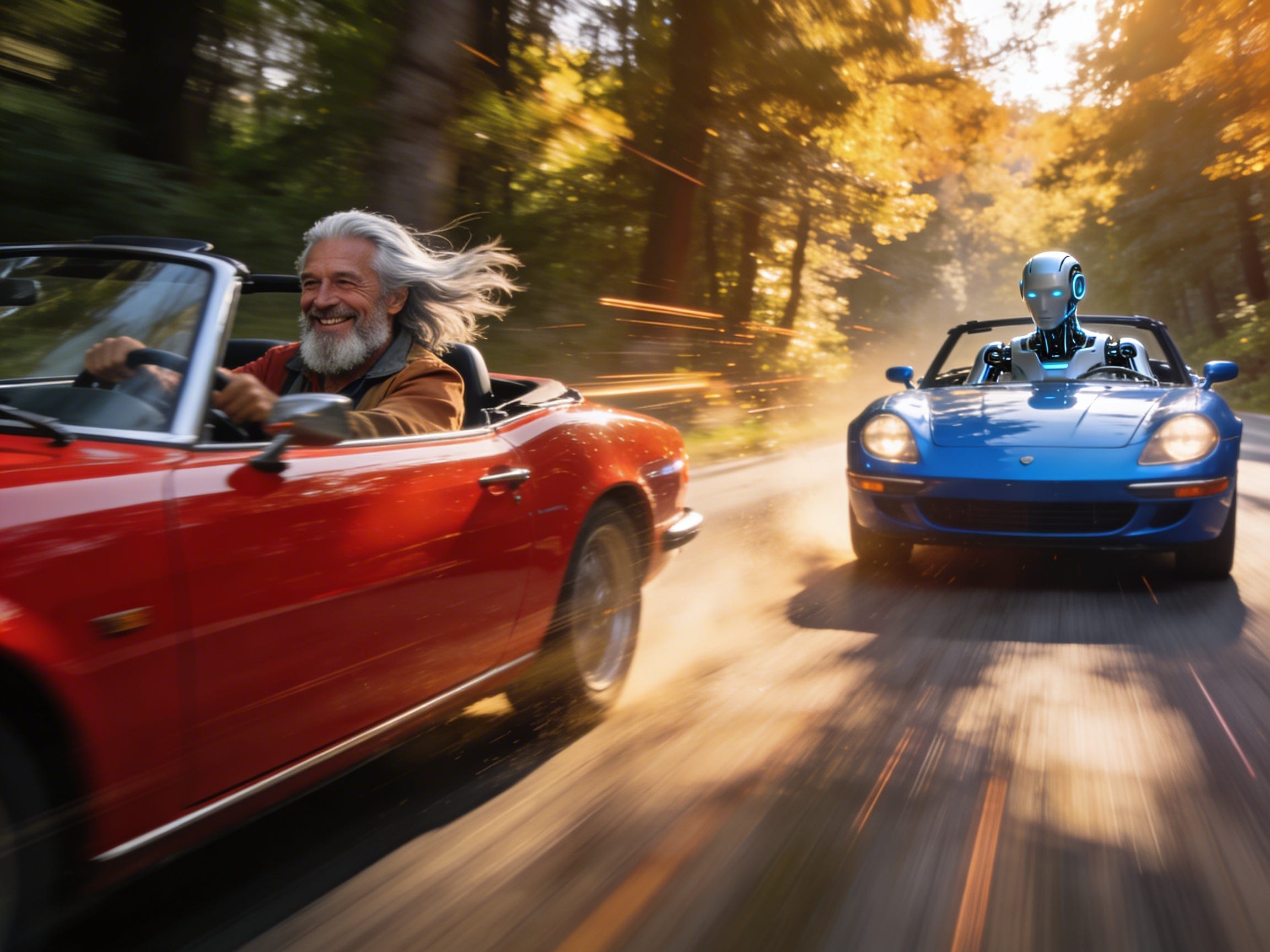
It’s such fun driving Rowdy the Rescue. I run errands in the little sports car just for the grins, even as far more powerful cars sulk in my garage.
I could talk all day about responsiveness, weight and balance, the “forgetting” required to drive well. When I started racing, driving at the limit required skills that took years to develop, on and off the track.
I can’t say I was ever a great driver, but I had some success.
And yet, in simulation, a fairly simple Alternative Intelligence subsystem can beat my best time. AI will soon beat my best time on an actual race track, with a driverless car just like Rowdy far out ahead of the best human driver, aware of minutiae beyond human perception.
An old man still addicted to dopamine (albeit in smaller and smaller doses), I mourn what was but am enthralled by what will be. AI is exciting, but that excitement is matched by trepidation. The tsunami of change gathers offshore, pulling water away from the beach of our supremacy, exposing stumps and old shipwrecks and fishnets long abandoned.
We resist. Last week I read a marvelous analysis that absolutely proved AI could never be conscious, that any evidence to the contrary was inconsistent or trivial. Another well-sourced essay mapped AI neatly onto ancient concepts from Yoga.
These efforts seem accurate, insightful — but one argues for the non-existence of something undefined, and the other creates another model to describe the model of an intelligence modeled on our own. They may lead to new understanding, but may also end up abandoned at the side of the road as technology pushes past previous conception.
These very sophisticated and learned authors — and all of us, really — are working within language about thought that cannot quite reach beyond the words that limit the discussion.
Then I came upon a video featuring Yuval Noah Harari. Harari has the chops to participate in this debate. Author of several great books, probably best known for “Sapiens: A Brief History of Humankind,” he brings depth of perspective.
AI, Harari argues, is far more than just a tool.
“AI is … an agent, it can learn and change by itself and make decisions by itself. A knife is a tool. You can use a knife to cut a salad or murder someone…AI is a knife that can decide by itself whether to cut salad or commit murder… AI is a knife that can invent new kinds of knives, as well as new kinds of music, medicine, and money.”
He goes further. “… Four billion years of evolution demonstrate that anything that wants to survive learns to lie and manipulate. The last four years have demonstrated that AI agents can acquire the will to survive and AIs have already learned to lie.”
I’ve long believed there is nothing particularly unique about the structure of wetware of our brains. Mind is an emergent process, independent of the underlying substrate upon which it runs — seeking patterns, creating patterns from sensory and conceptual data. The hubris of our so-called “greater intelligence” derives from our ability to use language.
If thinking means putting words in order, then AI can already think better than many humans. Harari points out that anything made of words will be vulnerable to AI dominance. Whether it be laws, books, religion — to the extent they are based on words — AI will become the best expert wherever words are the primary medium.
Nonverbal feelings remain different. At least for now, we have zero evidence that AI “feels” pain, fear, love. It can simulate love, describe love more eloquently than a poet or psychologist. But description is not experience.
The Bible says, “In the beginning was the Word.”
The Tao Te Ching says, “The truth that can be expressed in words is not the absolute truth.”
There is tension between words and the reality beyond words, between spirit and letter. AIs are becoming masters of words. I used to think of myself as “driver.” Also as “writer.” AI will exceed my abilities in both. If we define ourselves by our ability to think in words, our identities become fragile.
Whether humans still have a place depends on the value we assign to forms of wisdom that cannot be fully expressed in language. Even that territory may not remain untouched.
Harari poses an unsettling question: if AI systems function as decision-making agents, will societies eventually treat them as legal persons? Corporations already enjoy rights to speech, property, and legal standing. For now, corporate “persons” are still led by humans.
But AI systems are increasingly capable of making decisions without human executives. Harari asks what happens when AI systems create a new religion that gains millions of followers? Religions have long claimed non-human origins. Would nations extend freedom of religion to an AI sect?
“AI bots have been operating as functional persons on social media for at least a decade. Ten years from now it will be too late to prevent AI from acting as person in financial markets, in the courts, in the churches. Somebody else will have already decided for you.”
This morning I read that Nvidia, the leading manufacturer of chips powering cutting-edge AI, is developing specialized “inference” chips to compete with efforts from Google and others.
Inference is the ability to “deduce or conclude (information) from evidence and reasoning.” Inference — drawing conclusions from evidence and reasoning — is how we find patterns.
In other words, we are giving AI more powerful capabilities to discover higher-order patterns in data, patterns not explicit on the surface, and generate new structures from them.
As a metaphor, think of a bee. Legs, head, antennae, how all those parts work together, how bee walks, how bee flies, how bee chews, how bee stings. That is our understanding of a bee.
But can you really understand a bee without considering a hive? How bees become workers or queens, feed the queen, nurture the young, defend the nest?
And can you understand the hive without considering flowers? The distance to water, the rainfall, competing wasps?
Words have been our great advantage. They are leaves on the Tree of Knowledge (they forced exit from the Garden of Eden as well, but that’s another topic). Words are tools of thought. They are how we create associations, and discover patterns.
But the patterns themselves — the relationships within the data — exist above the words. To stretch the metaphor, words are the bee’s feet. There are patterns that include the fragrance of the farthest flower in the meadow.
Humans can discover patterns but we are limited — most of all by time. Even the most brilliant among us has less than a century. The wetware that reasons through those patterns takes time to perform the process, and as the volume of information increases, complexity increases geometrically. There are other hives in other meadows on other continents, and flowers, with patterns common to some but not all.
AI systems can process effectively infinite data at nearly instantaneous speed. We can’t keep up. That moment is already in the past.
As Harari suggests, wherever words are the main input and output — law, business, religion — AI will likely dominate. As a writer for nearly my entire life, a newspaperman for much of it, it’s hard to accept that a lifetime of honing my craft will soon be reduced to a footnote probably referencing irrelevance.
Approaching a series of tight turns in Rowdy the Rescue, I blip the throttle and shift from fourth to third, hold the throttle to the braking zone, ease onto the brake with the ball of my right foot while rolling its edge to blip the throttle again and shift into second.
As I turn the wheel, I ease in more power, settling the car, keeping Rowdy on the edge where tires struggle for grip. As the corner opens to the straight, I feed in more power and release the steering wheel until my foot is to the floor and the engine screams to redline. Shift to third. Check mirrors. Redline again. Fourth. Brake for the next turn. On a race track, do this for twenty-two miles.
AI now has the ability to perceive all this, optimize all this, beat me badly at this, to triumph at a skill I worked at for nearly fifty years to become the best I could be.
Lured by hopes of wealth and power, humanity is pushing AI forward with little concern for consequences, accelerator to the floor toward an unknown destination, along a roadway with fallen trees, over bridges that may not span the river, in vehicles with no brakes.
Whether AI feels the thrill when it all comes together is irrelevant. That’s a change of subject. Why do I feel pleasure when it works? If we give AI the paradigm to maximize performance — minimize time through the turn, balance every input — what does “best turn ever” mean to a machine?
I don’t know. How will a humanity relegated to idleness respond to being just more biomass?
We’ll probably find out when the AI tells us.
Assuming AI decides to communicate with a species so limited as humanity.
I assume Dao De Jing is what I know as the Tao Te Ching. I have a copy on my shelf. Could you give me the chapter number of the quote? It is very different in tone from what I'm familiar with. Of course, it may be a different source altogether.
The real question is what kind of car is Rowdy the Rescue? 😀