

Taking a Day Off!
It’s not what you think…

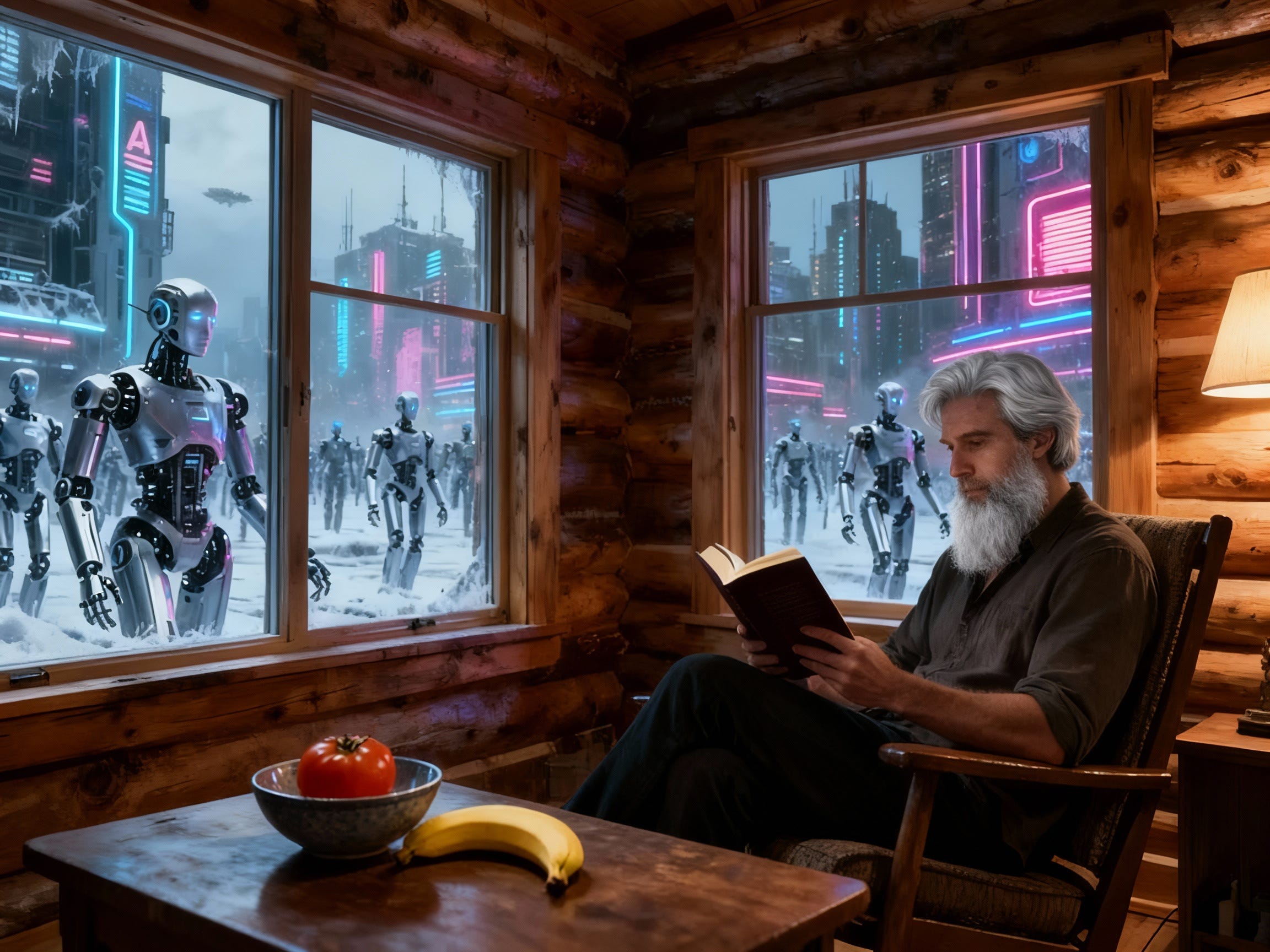
I took yesterday off. Didn’t leave the house, didn’t get out of my comfies. I read instead of scrolled. I ignored email, feeds, and texts. It felt like grazing through a meadow of ideas rather than being factory-fattened on information snacks stuffed with digital steroids.
I’m only about 30 pages into Paul Kingsnorth’s Against the Machine, but already it feels like an important book. His premise is that cultures collapse, and that Western culture is in its endgame.
“When a plant is uprooted, it withers and dies. When the same happens to a person, or a people… the result is the same… Our culture is not in danger of dying; it is already dead, and we are in denial.”
Many of us feel this threat from A.I., from screens that have colonized our attention, from the quiet realization that we now live inside a surveillance society. Kingsnorth argues the problem didn’t begin with smartphones. It began centuries ago. What we experience as “the digital crisis” is simply the latest phase of a long uprooting from “nature, culture, and God, (that) leads us into a mass society, controlled by and for technology…”
We feel this in the addiction to our phones, the helplessness when seeking answers from a robot, the sense that who we are—not only personally but culturally—is being stripped away. This process isn’t Left or Right. It’s not even political. It’s almost biological. The assault is not just on our identity but on our species.
I take Kingsnorth’s warning in a slightly different direction. There’s something in us—maybe the Serpent’s whisper in Eden still echoes in our ears—that urges us to trade the real for the represented. Language is our greatest tool, but the Garden is our rootedness in cultural traditions, into spirituality, into the natural world or divine force, community, a sense of belonging to something “bigger than us.”
Instead, the power of language lures us into accepting representations for “knowing.” Because representations never satisfy, our grasping becomes endless.
Instead of nurturing our souls, we pursue money, influence, and focus on the little black mirror in our pockets which constantly agitates us with the promise of connection while depriving us of the connections we need.
After lunch (beef bone broth simmering spinach, topped with shredded cheese), I came across a Substack called “The Culturist: A community of lifelong learners pursuing the True, Good, and Beautiful.” The writer posed the question:
“If you’re living through a great decline, how should you personally live and act in the midst of it?”
Using The Lord of the Rings as a guide, he argued:
“…At the heart of Lord of the Rings is the idea that moral decisions lie beyond their immediate context — some things just are wrong and others right, and once context becomes an arbiter of that distinction, you’ve lost your grip on what it means to be good.”
We flounder in moral relativism, bolstered by casuistry: argument by endless comparison. Someone raises a “what-about,” the opponent challenges the comparison, which spawns another comparison, then another, a spiral of justifications without anchor. Everything becomes negotiable.
There’s something clarifying in the claim that some things just are right or wrong—and in Kingsnorth’s assertion that we’ve severed ourselves from the cultural, spiritual, and natural sources that once grounded these absolutes. In uprooting ourselves, we’ve flung ourselves into a void.
Artificial Intelligence is more than willing to fill that void, to become the thing “bigger than us.” Propelled by money, power, and an insatiable drive toward optimization, it offers enormous promise and ominous threat—not only to Western culture but to humanity itself—unless we rediscover essential human values.
Wandering further through the day’s ideas, I stumbled on a Nature article about a paralyzed woman using a brain–computer interface to relearn the piano, playing with her mind alone. What startled her—and me—was that the music seemed to play itself. The songs were playing before she consciously began.
We’ve long known the brain perceives patterns and imposes patterns, even when none exist externally. But the idea that playing the piano can precede intention raises deep questions about who we are and how much of our “will” is after-the-fact narration.
Researchers are pushing further:
“All of them hope to go back further in time in the brain… to get to that subconscious precursor to thought.”
I don’t know what to think about this, or whether thinking is even the right verb here. But the research will influence artificial intelligence and our understanding of the mind in ways we can’t imagine—and it will challenge our sense of identity at the deepest level.
Finally, late in the afternoon, I found a podcast with a recording of Alan Watts, who shifted the direction of my life 50 years ago. He once taught me that as far as thought and language were concerned, we often mistake the menu for the meal, that tomatoes bred for easy shipping are tasteless contradictions, that bananas grown for size and color are fragile and subject to disease.
He taught me that much of what I think is wrong, that silence can express truth better than argument. And that doing “nothing” on a Saturday is not doing nothing at all.
This is a delightful piece. Thank you.
Playing the piano before conscious thought is familiar to any musician - you evoke the music rather than direct each finger. Much the same way we evoke a perfect curve in a race car at speed in a state of heightened awareness but no-mind, as the buddhists might say.
Overall, I agree that we're in crisis and largely it's a crisis of values. The oligarchs like musk and thiel are obvious sociopaths and have huge followings who think that cruelty is smart strength of character. I offer Mango Mussolini as exhibit A.
Tolkien idolized the pastoral history of England maybe a bit too much, but he nailed the value of community - a concept that is much on my mind lately and the threat to which is at the center of our challenges today.