

The Medina
Unlike Any Place Else…

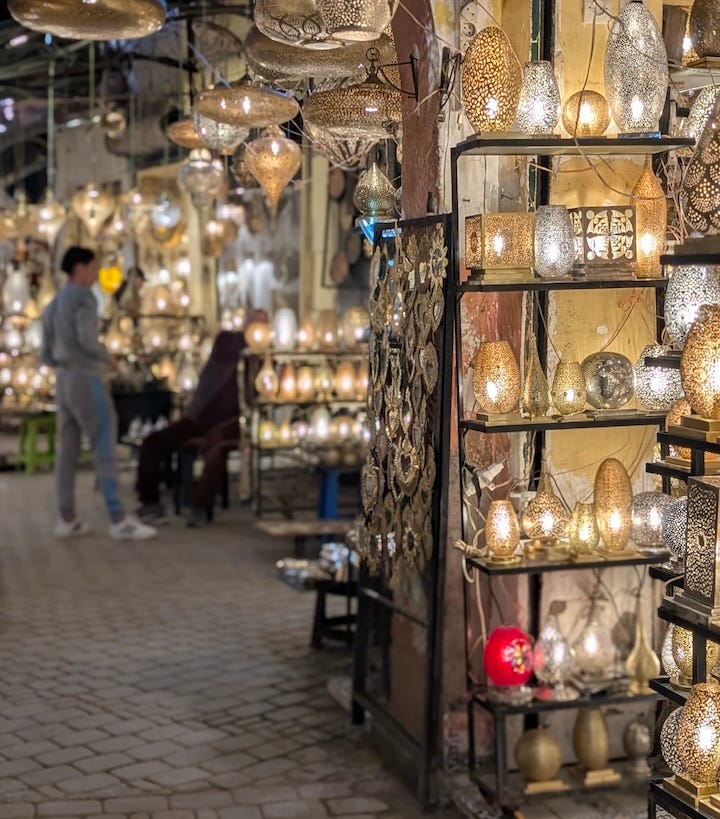
The medina of Marrakech is distilled intensity.
There are no metaphors that convey the impact of the noise, the colors, the contrasts of opulence and poverty, deep waves of history shown by peeling walls offset by racks of knock-off Louis Vuitton and Hermes; snake charmers and monkey handlers under tents erected over cobblestones of the great square and demanding 100 dirhams ($10) after insisting you take a photo of him teasing a black cobra with his hat, scornfully first refusing 20 dirhams but then accepting the proffered bill with a sneer and a shrug, after you start to walk away; barkers standing in your path to force you into their food stall until you let them know with a glance of certainty and a tilt of the head that you’re not so inclined; stalls 15 feet deep of brass that fills shelves and tables of golden sheen, lights and plates and statues and magic lanterns the size of a deck of cards (for small genies) or the size of a four-slice toaster, men squatting by the curb powering small lathes with a bow pushed and pulled between their legs with one hand forming chess pieces or honey spoons with a sharp chisel angled to the wood, foot used as a fulcrum.
And more. Not twice more, not five times more or a hundred times more, but an onslaught of as much more as you can absorb, until your senses are overwhelmed.
There are the crowds, a constant surge of bodies through the narrow passages, French and English and German and Spanish and Belgian and Swedish and American, wearing European finery of linen and silk or denim and cotton, slacks or shorts, among women of Marrakesh wearing burkas from head to toe with only a slit below their brow and above their nose showing dark eyes, sharp and confident; then again for the fifth or tenth time in the last three minutes a motorbike zooms at you from the front or up to you from behind, with a young man or a woman cutting in and out of the river of people, maybe with their partner and their child holding a shopping bag and a mirror not an inch — sometimes not a quarter inch — from clipping some tourist, passing a cart pushed by a man or pulled by yet another buzzing, smoking scooter, letting everyone know with a “beep” that they need to get through the crowd on their way to pick up or deliver a load.
And then you hear the call to prayer played over loudspeakers, round and the size of truck tires.
The call permeates the day, raspy and shrill and insistent, demanding attention, obedience; prayer is optional but not if you aspire to heaven. We are told by Hassan, a guide who took us to the oldest school in the world, maybe — that wasn’t clear and I think he was prone to exaggeration, that the five tenets of Islam are Faith, Prayer, Charity, Fasting, and at least one journey to Mecca in a lifetime.
We’re told no one goes hungry in the medina; if someone is hungry, neighbors will make sure there is something to eat because Islam demands charity from all.
“Better that the need is met directly rather than go through bureaucrats,” Hassan said, before explaining the significance of the five-sided diagrams (the five tenets of Islam), the six-sided geometries (the world was created in six days), and the eight-sided figures whose meaning I wasn’t close enough to hear. Hassan said the Koran is of the words of Mohammed, that it recognizes the Torah and the Bible, and the figures of Judaism and Jesus as prophets. But in Islam Mohammed is the “last prophet,” his words directly from Allah and written into the Koran, and Allah is the one and only God and in fact there is no plural for the word “god” in Arabic.
Not as different from Judaism and original Christianity as one might think.
Turning into the alleyway of stalls with baskets and jars of endless varieties of olives, one is bathed in an aroma so complex, rich, full, layer-upon-layer of fulfillment, oil-upon-oil deeper than any mere bottle or dressing, it seemed like a flood of the scent of green and tan and black of olives, abundance flowing from baskets and jars.
Walking past the leather shops where elegant purses and knock-offs of designer sandals hang, I’m conscious of a lingering smell of slaughterhouses and tanneries where world-class leather is tanned and softened and dyed and sewn.
My friend Marcel’s grandfather was from Morocco, hence his French/Moroccan name. Marcel is a businessman and a chef, has both discernment and appreciation, and he runs a finger along a handbag as we walk by a stall buried in the market and mutters something about the fineness of the leather. He sees a new design from Nike has already been replicated. He examines with fingertips the weight and stitching from just a corner of carpet hanging in front of the next stall.
When Susie is bargaining with a vendor for a pair of sandals, she gets the price from D1000 down to D600, and Marcel tells her to offer to buy two pairs for D700. Deal.
We drove into the Atlas Mountains for what was supposed to be a three- or four-hour trip. We left at ten, and got back about five. I was in the front seat and pressed our driver for an impression of American politics. At first he demurred, saying that all people want what’s good for them, Trump wants what’s good for Trump, Iran wants what’s good for Iran.
But then he said he wept when he saw on the news the wife of an American serviceman killed, leaving behind a young wife and son. “This is the outcome of war,” he said.
It’s possible to be jaded after growing up among sword ferns and the wet drip of maples and firs in western Oregon, walking between mountain glaciers of the Cascade Mountains, playing among the volcanoes, hanging about on the voluptuous waters of Puget Sound and British Columbia.
But this… this… Marrakech is as different from home as the City of Oz, in many ways feels like it may have been that film’s inspiration.
Sooner than we anticipated, the intensity above all else, I think, prompted an early exit from the medina. We moved closer to the airport for an easier exit from Marrakech. It was so much, just so much — there was no more space to pack in even one more experience, even one more sight, sound or smell.
It was time to move on.
I love markets because they are quintessentially human. You can take someone from ancient Rome or China or the middle ages and plunk them in that Medina or the night market at Longshan Temple in Taipei, and they would understand what was happening and how it works. A market is the sine qua non of human civilization.