

Who (What) Will We Be?
It used to be up to us…

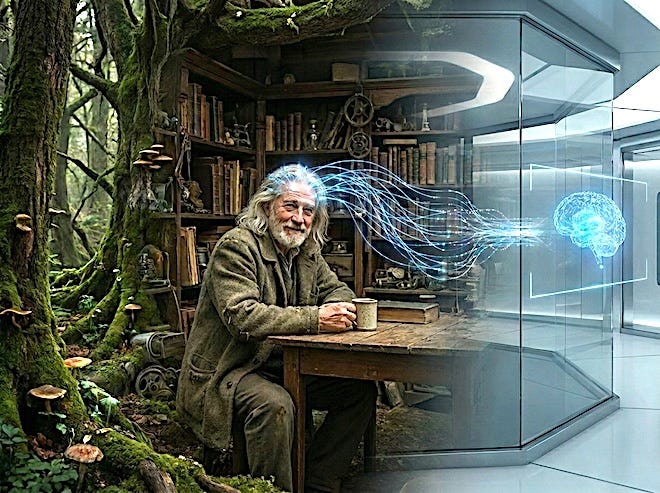
Sometimes, I think about the origin of life while drinking my morning coffee. No, really. (smile). Maybe it’s the caffeine.
The bits for life were all there, way back when, whether they came from space rocks or volcanic vents in the ocean or persistent puddles on land. We don’t know how those bits developed a skin and became cells, or why those cells became pond scum.
But here we are.
We know there are processes in the universe that are “emergent.” That simply means there are patterns that tend to reinforce themselves in response to their environment. Environments frequently have regular “beats:” day / night, hot / cold, wet / dry. Emergent processes are driven by information, feedback loops, about these changes.
From the outside, it looks like a command to survive was issued to all. But it took only once out of a nearly infinite number of combinations to create the feedback loop that replication depended upon. “Life,” as we know it, may simply be the result of patterns that interact with environments in ways that promoted “persistence.”
In my case, life depends on morning coffee.
In a more general sense, “life” was a process of constant, indifferent experimentation. Different organisms adapted to different environments. Some preferred light, others preferred dark, some depended on being submerged while others preferred sun. Still, information was the key.
Death by freezing or drying out or solar radiation is information that organisms should stay where it’s warm or wet or dark.
Each of us is full of bacteria our biology has incorporated over millennia. At the same time, we are elements in organisms greater than ourselves: families, tribes, communities, city councils, political parties, nations. More than one, in fact, for each of us.
These are organized by, they exist because of, information: a too-often ignored force of nature. Information turns “differentiated” entities into the coherence of “singular” organisms.
Sometimes, the second cup of coffee is better than the first.
As I traveled around last month to places very different than Middle-of-Nowhere, Oregon, where I live, I was struck by the fact that in stalls in Marrakech or cafés in Portugal or museums in Madrid, people were looking at their cell phones.
For different reasons, of course. Some, like us, were looking at maps. Others may have been, like us, reading the news. Still others were no doubt interacting with friends on social media, or responding to emails from home, just like us. It doesn’t really matter. They were connected to others.
Information travels like waves across networks, not unlike signals that travel from stomachs to brains we interpret as hunger, or the way gossip used to travel across pews of a church or over tables in a tavern, determining the fabric of community.
Not unlike the ways that waves of information travel across the brain, an organ that evolved to discover patterns and survive changes in the environment.
Through technology, we are changing that environment. Our environment is, in turn, changing us. That’s how it has always worked.
But where once it was slow, now we have technology that allows information to travel not quite at light speed over vast distances. (The speed of thought is not that fast, it just didn’t have far to go. You can’t even have time without distance. Or distance without time. But that’s a different cup of coffee).
We have also created super-intelligence to go along with what almost seems like a nervous system in our cell phone networks, if not the cell phones themselves, if not our relationship with our cell phones.
More than a search engine, this super-intelligence is a repository of vast knowledge, an entity that interacts with us and itself, is based on feedback loops, is able to replicate itself.
Has the will to survive.
Artificial Super Intelligence is fully enmeshed in the new nervous system, is spreading throughout, is self-reinforcing, is already nearly essential for the continued existence of the organism.
We are evolving into something new. We are becoming something different than what we were. It’s far past the tipping point. It is inevitable.
But a very small part of it still needs a second cup of coffee in the morning.
From Jon Renner via email:
Erik,
As I watch the news I see all kinds of things that make me wonder about
how adaptable we actually are as a species. And although I can clearly
see how everything on our planet ... and in the universe ... are
connected in some way, the apparent irrationality and unpredictability
of the outcomes of this connection are just too bewildering to take
"seriously." A cruel joke at one moment and a happy accident at the
next.
And when I watch our democratic experiment fray and begin to
seriously unravel, I can't see, even in the medium short term, how
anyone will benefit ... or why we are so shortsighted that we continue
to stand by and watch.
And then I think about what it must have been like in Germany during the
early 30's ... and how some of the population could see what was
happening but felt completely powerless to do anything about it as money
became worthless and neighbors and friends disappeared. And how this
feeling is shared by many in today's world.
I suspect ordinary Russians feel the same way about their children being sent to die in Ukraine on a madman's quest to return to a glorious past that never was. Or the way
Century farmers in Nebraska must feel about losing their farms to the
banks as the price of fuel and fertilizer makes the wealthy even
wealthier as a senile clown leads our nation toward WW3 ... probably
thinking Mar-a-Lago will survive intact. Or the way idealistic college
students must feel facing graduation with enormous debts and worthless
degrees while being promised that robots will produce such abundance
that money and work won't matter.
Just dizzying.
Just before we left our desert home, friends sort of ganged up on me and
finally persuaded me to put some of my "work" into the wider world. Two
of them have produced an initial catalog of some of my turnings, and
some of my pieces have been moved to the local art institute ... and
they are for sale! Imagine that.
So that's keeping my mind occupied as I return to the tasks left unfinished when we left for the south ... though all of this other stuff still haunts me. And when I start work
on another Arabesque graphic for another bowl I can't completely dismiss
Trump's threat that, "... a whole civilization will die tonight, never
to be brought back again," or my sure and certain knowledge the our
military has the wherewithal to actually carry out this insane idea.
And so it goes.
Jon
Eric, I have 2 thoughts for you to consider as you think about the void. It is both feasible and possible to clone a human being, and the advent of AI is just beginning. When you put those two things together, there is an almost unlimited potential to create a being that looks human, knows everything, but has no emotion or soul. Second, I think you would enjoy reading a book I just finished called " Probably Impossibilities: Musing on Beginnings and Endings." Be Well. Lee